17
Apr
2026
Beyond Asana: The Complete Path of Yoga with Srivatsa Ramaswami
For many practitioners, yoga begins with the body.
We learn postures. We build strength and flexibility. We begin to understand alignment and breath. For years, this can feel like the entirety of the practice.
But at a certain point, a deeper question arises.
What comes after asana?
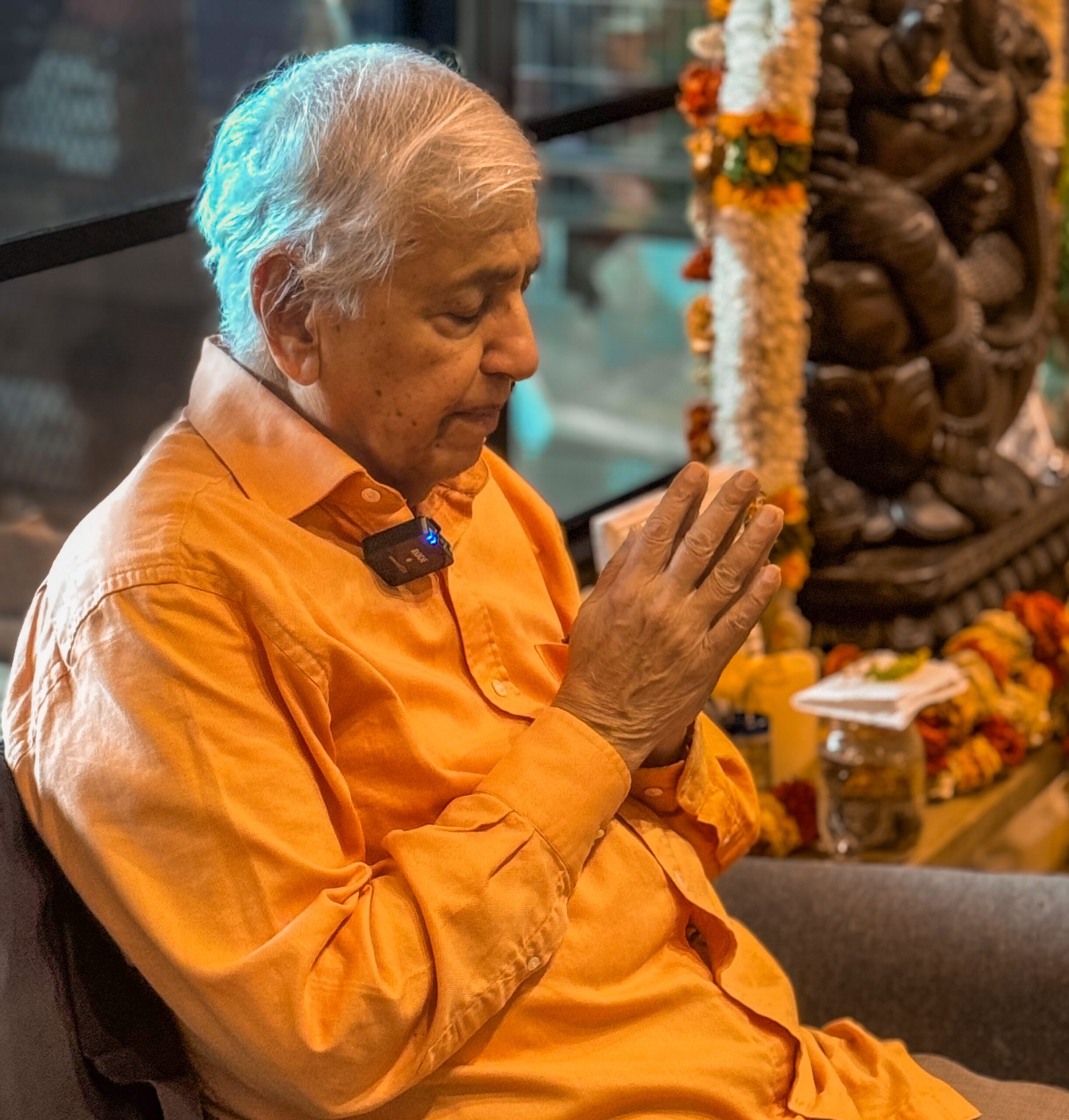
In a recent conversation on the Yoga Inspiration Podcast, Srivatsa Ramaswami, one of the last direct students of Krishnamacharya, offers a clear and grounded answer. Yoga was never meant to stop at posture. It is a complete system, one that unfolds over time and evolves alongside the practitioner.
Ramaswami’s own introduction to yoga was not through seeking a teacher, but through circumstance. Krishnamacharya came to his family home to work with his brother, and over time, the entire household began practicing together. What began as asana instruction gradually expanded into something much more comprehensive. Chanting, pranayama, and the study of classical texts became central to the practice.
This progression was not accidental. It reflects a core principle in Krishnamacharya’s teaching: yoga must be adapted to the individual and to the stage of life.
In the early years, practice emphasizes asana and vinyasa. The body is developing, and movement builds strength, stability, and coordination.
In the middle stage of life, the focus shifts. Pranayama, meditation, and study take on greater importance. The practice becomes less about physical capacity and more about regulating the breath and steadying the mind.
Later in life, yoga becomes contemplative. The practitioner turns inward, reflecting on the nature of the self and the deeper philosophical questions at the heart of the tradition.
This structure is not a rejection of asana, but a recontextualization. Posture is one part of a much larger system.
Ramaswami emphasizes that many practitioners remain within the physical dimension of yoga without realizing what lies beyond it. Yet the classical teachings, particularly the Yoga Sutras, offer a detailed and systematic path forward.
Pranayama refines the breath and calms the fluctuations of the mind. Mudras and bandhas deepen internal awareness. Chanting and mantra introduce rhythm and focus, bridging the external and internal aspects of practice. Meditation develops sustained attention, gradually reducing the constant movement of thought.
These are not separate practices, but interconnected elements of a single path.
Within the Vinyasakrama system that Ramaswami preserves, even asana is approached with this depth. Movement is not random or purely aesthetic. Each posture is prepared for through specific sequences, each transition guided by breath. The purpose is not simply to achieve a shape, but to create the conditions for stability, clarity, and long-term practice.
This same logic extends into the more subtle practices.
Yoga, in this view, is not something to be completed. It is something to be studied over a lifetime.
Ramaswami often reminds students that the teachings of yoga are not abstract philosophy. They are directly related to one’s own experience. The study of texts such as the Yoga Sutras or the Sankhya Karika is not intellectual for its own sake, but a way of understanding the nature of the mind, the breath, and the self.
Even a small, consistent effort can lead to profound depth over time.
A few minutes of study each day. A steady pranayama practice. A gradual refinement of attention.
These are the elements that expand yoga beyond the mat.
Listen to the full episode of the Yoga Inspiration Podcast with Kino to explore this conversation in depth.
For those interested in studying directly with Ramaswami, join a live Vinyasakrama class on April 19 through Omstars. Then continue your practice in his 100 Hour Training, May 11 to 30, available online through Omstars and in person at Miami Life Center.