28
Aug
2026
Before You Begin the Intermediate Series
There is a particular fascination that surrounds the Intermediate Series of Ashtanga Yoga. For many practitioners, it represents the next frontier of the practice, filled with deeper backbends, leg-behind-the-head postures, demanding strength transitions, seven headstands, and some of the most iconic asanas in the Ashtanga system. It can be tempting to think that beginning Intermediate Series is primarily a question of physical ability. Can the body bend deeply enough? Is there enough strength? Can the practitioner stand up from Urdhva Dhanurasana, put a leg behind the head, balance on the forearms, or eventually lift out of Karandavasana?
Yet the most important preparation for Intermediate Series is not found in the body. It is found in the mind.
Before beginning Nadi Shodhana, the traditional name for the Intermediate Series, what matters most is the development of a mind that is strong, steady, focused, and calm. Physical ability matters, but without this inner foundation, the very intensity that makes Intermediate Series transformative can also make it overwhelming.
The Body Is Not the Qualification
There have always been practitioners who arrive at yoga already capable of extraordinary physical things. One person drops naturally into a deep backbend. Another possesses so much strength that inversions and arm balances come almost immediately. Someone else discovers that putting a leg behind the head requires surprisingly little effort.
None of these abilities, by themselves, constitute a practice.
There is an important difference between being able to do an asana and integrating that asana into a daily sādhana. A pose might be practiced because it feels good, because it stretches something that needs to be opened, because it strengthens something that needs support, or simply because it is enjoyable. All of these are perfectly valid reasons to practice an asana.
Daily practice asks something different.
When an asana becomes part of sādhana, the practitioner begins a relationship with it. The pose is practiced repeatedly, not only when it feels good or when the body seems particularly capable, but through the changing conditions of life. There are days when the pose feels expansive and effortless, days when it feels difficult, and days when it simply feels boring. After enough years, even the most dramatic postures of Intermediate Series can become ordinary.
Integration means learning to meet the practice through all of these conditions.
Without that foundation, something predictable can happen when Intermediate Series is introduced too quickly. Instead of deepening the practice, it overwhelms the practitioner.
What the Asanas Actually Do
The traditional name for Primary Series is Yoga Chikitsa, yoga therapy. Intermediate Series is called Nadi Shodhana, purification of the nāḍīs, the subtle channels through which prāṇa is understood to move.
These names suggest different intentions.
Primary Series is certainly physically demanding, but its overall energetic movement is often grounding and introspective. There is a therapeutic quality to its repetition, and the sequence offers many possibilities for adaptation while still maintaining its essential purpose of strengthening, balancing, harmonizing, and calming the system.
Intermediate Series has a different character. Any asana can be modified, but modification does not necessarily change the underlying energetic intention of the sequence. Nadi Shodhana stimulates the system in ways that Primary Series does not, which is precisely why a different level of mental steadiness is useful before beginning it.
The asanas are not understood within the yoga tradition merely as exercises for stretching muscles and improving physical health. They also operate within the subtle body. When Intermediate Series becomes a regular practice, the practitioner enters into a different energetic terrain.
For someone whose mind is already relatively grounded, this stimulation can be integrated. When the mind is highly restless or unstable, however, the same intensity can amplify what is already present. Rather than feeling more balanced after practice, the practitioner may feel emotionally overwhelmed, energetically unsettled, or overstimulated.
Sometimes the response is simply to quit.
Years later, the story may still be remembered: Ashtanga was wonderful until the practice became too demanding, until a difficult pose had to be repeated every day, until something that once felt exciting became too much. The problem may not have been the pose itself. It may simply have been introduced before there was enough foundation to absorb it.
The Sparkling Water Principle
A useful image is a bottle of sparkling water.
Some practitioners arrive with a naturally calm and focused disposition. They memorize sequences quickly, connect to the breath easily, and instinctively understand how to remain present inside repetition. These qualities are difficult to teach, although they can certainly be cultivated.
Other practitioners arrive like a bottle of sparkling water that has just been shaken. The moment the cap opens, everything comes rushing out.
If the bottle is already overflowing, shaking it harder is unlikely to help.
Intermediate Series can function like that additional shaking. Occasionally an intense practice can be exciting or even illuminating, but as a daily discipline the intention is not simply to create greater intensity. The purpose is to create conditions in which intensity can be integrated.
This requires honest self-inquiry. What is the actual state of the mind? Does concentration arise relatively easily? Can attention remain connected to body and breath? Is the mind restless, scattered, or continually pulled away from the practice?
A practitioner may be physically capable of performing every posture in Intermediate Series and still benefit from remaining with Primary Series until greater steadiness develops.
Settling has its own rhythm. When sparkling water begins rising toward the opening of the bottle, the cap can be loosened slightly and then held. The bubbles settle. Then it opens a little more.
Practice can unfold in much the same way.
For one person, establishing the necessary foundation may take a week. For another, several months. For another, years. Pattabhi Jois sometimes joked that for some students it might take several lifetimes. There is no need to know in advance which category anyone belongs to.
One of the simplest signs of readiness is surplus energy. When Primary Series has become stable enough that the practitioner regularly finishes with energy remaining, the body may be indicating that it has room for more. The opposite is equally informative. If practice ends in complete exhaustion, if Savasana becomes an unintended two-hour nap, the body may be asking for restoration rather than another collection of difficult postures.
The Rule, and the Period Before the Rule
There is an entire body of old-school Ashtanga lore surrounding who is qualified to begin Intermediate Series. For many practitioners, these stories create a strange combination of reverence and anxiety. There can be a sense that one is somehow not good enough, not advanced enough, or perhaps about to violate an ancient law of yoga by practicing a posture too soon.
For a period of time, the commonly enforced rule was clear: before beginning Intermediate Series, the practitioner needed to be able to drop back into Urdhva Dhanurasana and stand up again independently.
Many dedicated students worked for months or years to meet this requirement. For some, the rule provided useful motivation. For others, enormous effort was spent trying to force a body to satisfy a standard that may never have been appropriate for its structure.
The question raised by practitioners was reasonable. The beginning of Intermediate Series consists largely of backbending. If these postures develop spinal extension, why not use them to help prepare the body to stand up from a backbend?
The strict traditional answer was that standing up and dropping back represented the threshold through which the practitioner had to pass.
Yet bodies do not always conform to rules. Structural differences, injuries, surgeries, aging, and individual anatomy all matter. Someone with fused vertebrae or spinal hardware may never stand independently from Urdhva Dhanurasana, while still being capable of benefiting from carefully selected postures of Intermediate Series once Primary Series has been sufficiently integrated.
It is also important to remember that there was a period before this rule.
In the smaller Lakshmipuram shala in Mysore, Pattabhi Jois sometimes taught Intermediate Series postures to students who had not yet mastered standing from a backbend. The practice was being taught to relatively small groups, which allowed for a degree of individual attention that became increasingly difficult as Ashtanga grew internationally.
With twelve students, a teacher can observe each practitioner closely and make individual decisions. With fifty, eighty, or two hundred students, some degree of standardization becomes necessary.
Seen from this perspective, the drop-back requirement may be understood not only as a philosophical principle but also as a practical teaching tool. A student who can independently drop back and stand up has already demonstrated a substantial degree of spinal mobility, strength, coordination, breath control, and familiarity with the practice. In a very large Mysore room, that becomes useful information.
The deeper question is therefore not simply, Have I passed the test?
It is: How much help will I need?
A sustainable practice develops increasing self-sufficiency. The practitioner learns to do as much as possible independently while recognizing the precise places where assistance is genuinely useful. The goal is neither absolute independence nor complete dependence on the teacher, but an intelligent relationship between personal responsibility and appropriate support.
Reading the Map of Intermediate Series
Understanding the architecture of Intermediate Series makes its internal logic easier to see.
The opening section is dominated by spinal extension and builds toward Kapotasana, one of the defining backbends of the sequence. Kapota means pigeon and is also associated with the sage Kapota. Kapotasana asks for a powerful combination of mobility and strength, gathering deep spinal extension, shoulder mobility, hip extension, and posterior-chain support into a single demanding posture.
Kapotasana is often described as a gateway pose because it concentrates lessons introduced throughout the preceding postures. A gateway pose should not simply be forced, bypassed, or hurried through. It asks the practitioner to discover what meaningful work in the posture actually looks like.
Integration can be measured by relatively simple signs. Is deep breathing possible? Can the mind remain calm? Can emotions be regulated inside the intensity? Does the practitioner emerge feeling basically well rather than dizzy, disoriented, or overwhelmed?
If several minutes of rest are necessary afterward, that is information too. Rest may be exactly what is needed while the nervous system and body learn to accommodate the pose.
The next major movement of the series shifts toward deep hip flexion and the leg-behind-the-head family, eventually arriving at Eka Pada Sirsasana, Dwi Pada Sirsasana, and Yoga Nidrasana.
Here again, the order matters.
Eka Pada and Dwi Pada Sirsasana require not only flexibility but considerable active strength and control. Yoga Nidrasana emphasizes the flexibility component more strongly. It might seem logical to practice the more passive flexibility posture first, but pulling the legs deeply into position without sufficient active strength can make it easier to move outside healthy alignment. Strength creates the foundation from which flexibility can be expressed more safely.
Anatomy also creates enormous individual variation. A practitioner with long legs and a short torso, for example, may have a beautiful Supta Kurmasana and still find seated Dwi Pada Sirsasana unexpectedly difficult. The proportions simply change the geometry. The legs may cross easily on the floor and then, upon sitting upright, land directly on top of the head like a peculiar yogic hat.
These moments are useful reminders that physical accomplishment cannot be separated from individual structure.
The Mighty Himalayan Duck
After the leg-behind-the-head sequence, Intermediate Series moves toward increasingly dynamic expressions of strength.
Some of these movements are immediately accessible to people with certain athletic backgrounds. Someone accustomed to plyometric push-ups may find Nakrasana surprisingly straightforward despite having little yoga experience. Again, being able to perform one spectacular movement does not mean the entire series has been integrated.
The closing strength sequence asks for coordinated power through spinal extension and flexion, shoulder stability, inversion, and dynamic movement.
And then there is Karandavasana.
Kāraṇḍava is traditionally translated as a type of waterfowl, often rendered as a Himalayan goose or duck, an appropriately charming name for one of the most notoriously difficult postures in the Ashtanga system.
Karandavasana asks the practitioner to lower the folded legs toward the arms from Pincha Mayurasana and, eventually, lift them back up again. For many practitioners, the descent comes long before the ascent. Some may always use assistance to return upward, and that does not invalidate the work of the posture.
There was once a period when practitioners could remain at Karandavasana for months because they were not given additional postures until they could lift back up independently. Stories from Mysore include extraordinarily strong practitioners spending month after month attempting the lift until one day, somehow, the movement finally happened.
Over time, this rule also softened.
Both Pattabhi Jois and Sharath Jois increasingly helped students rise from Karandavasana. During one of Sharath’s later led Intermediate Series classes, he moved through the room assisting practitioner after practitioner, sweating and breathing hard from the effort of lifting so many bodies.
“It is like weightlifting,” he joked.
Perhaps Karandavasana offers another lesson hidden inside the physical one. Independence matters, but so does compassion. Sometimes the practice asks practitioners to lift themselves. Sometimes it teaches them to accept a hand.
Even Himalayan ducks occasionally need help flying.
The Seven Headstands and the Importance of Closing
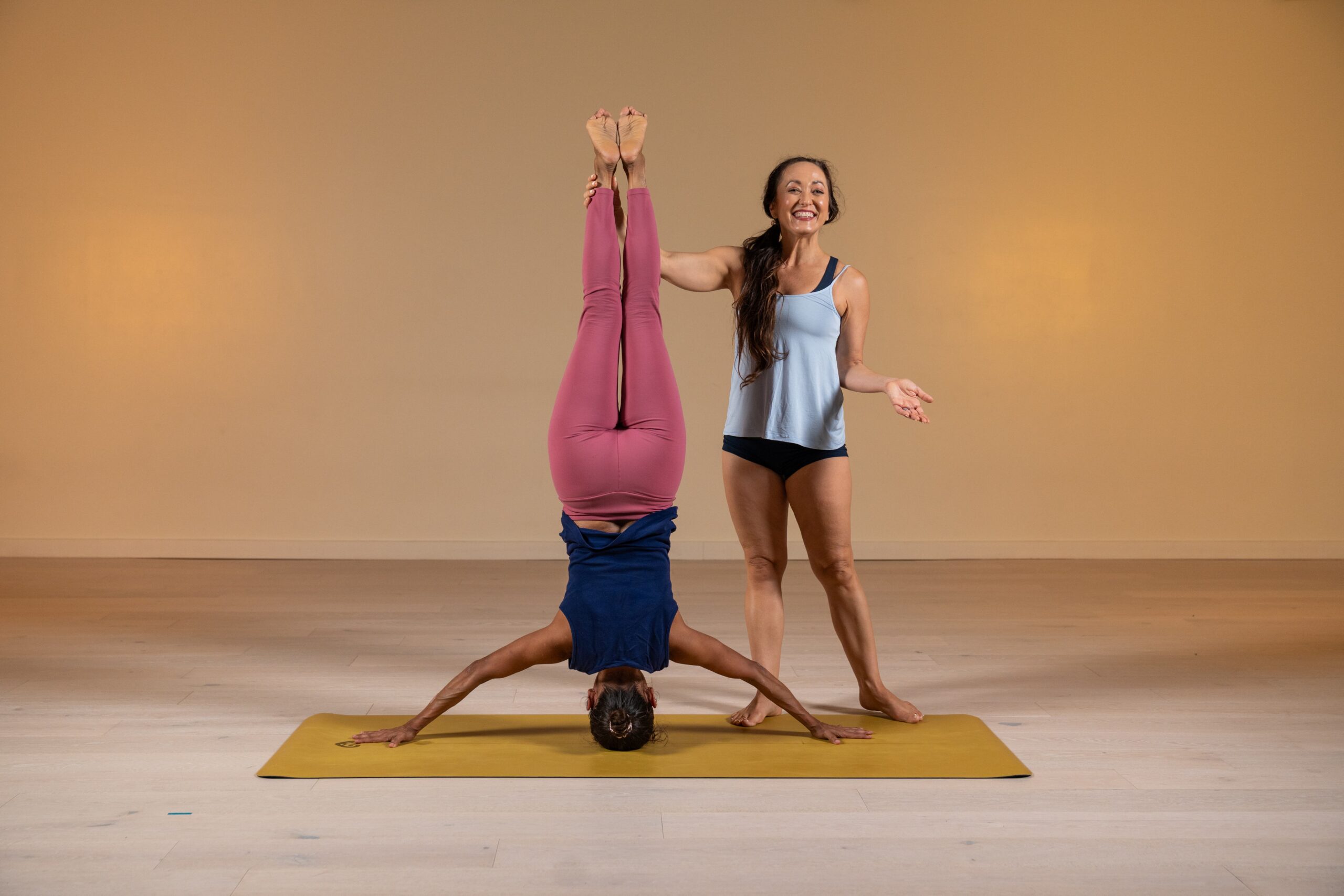
The architecture of Intermediate Series does not end with its most difficult strength postures. The seven headstands play an important role in bringing the sequence toward integration.
The organization of the Ashtanga series has changed over time, and in earlier arrangements the seven headstands existed with a somewhat more independent status before becoming associated with the conclusion of Intermediate Series. Whatever their historical placement, their location near the end of Nadi Shodhana makes energetic sense.
After the stimulation of deep backbending, intense flexion, leg-behind-the-head work, inversions, and dynamic strength, sustained inversions help gather attention toward the central axis of the body. The closing sequence then gradually shifts the practitioner toward stillness.
This is one reason not to neglect closing poses after Intermediate Series.
When the full seven headstands are not practiced, a longer closing sequence can serve an important integrating function. Shoulderstand and headstand can be held somewhat longer, followed by sufficient rest.
Intermediate Series can sometimes leave emotions heightened, the body trembling, or internal heat continuing long after the final demanding posture has ended. These experiences are not necessarily signs that something has gone wrong, but they do indicate that the practice has stirred the system considerably.
The closing sequence is part of the practice, not an optional addition to it.
Once You Start, Keep Going
Perhaps the most important advice for beginning Intermediate Series is also the simplest: once the journey begins, find a sustainable way to continue.
Many practitioners love Primary Series and then discover that Intermediate Series asks for something entirely different. The poses feel unfamiliar. Progress slows. Movements that once seemed relatively easy are replaced by postures that may require months or years of patient work.
That is exactly when the temptation to abandon the series becomes strongest.
Continuing does not mean forcing the body through every posture regardless of circumstances. It may mean changing how Primary Series is practiced to create space for the new work. It may mean practicing an accessible version of a posture. It may mean staying with one section for a long time while the body, breath, nervous system, and mind gradually understand what is being asked.
What matters is maintaining the thread.
When Intermediate Series is practiced only occasionally, it can remain perpetually foreign. With consistent practice, the body begins to organize itself around the new demands, the mind becomes familiar with the territory, and what once seemed impossible slowly becomes part of the practitioner’s internal landscape.
Everything learned through Primary Series becomes relevant again: patience, endurance, perseverance, courage, forgiveness, compassion, and the willingness to return tomorrow without demanding that tomorrow be dramatically different from today.
This may ultimately be the real qualification for Intermediate Series. It is not a particular backbend, a leg behind the head, or the ability to lift a Himalayan duck back into the sky. Physical benchmarks can be useful, but they cannot measure the quality that matters most.
Before asking whether the body is ready for Intermediate Series, it may be more useful to ask something simpler:
What is the state of the mind, and can the practice be met from there?
Join us September 1 to 21 for the Ashtanga Yoga Intermediate Series Challenge on Omstars. Over 21 days, you’ll move through step-by-step tutorials, targeted drills, and guided practices designed to help you understand the method behind the postures and build a steadier relationship with Second Series.
Enter your email to receive a free downloadable Second Series practice chart, get the first three days of the challenge free if you are not already an Omstars member, and enter for a chance to win a one-year Omstars membership.